BalanceDuel
Game Overview
Can You Stay Upright While Knocking Out a Fire-Breathing Knight?
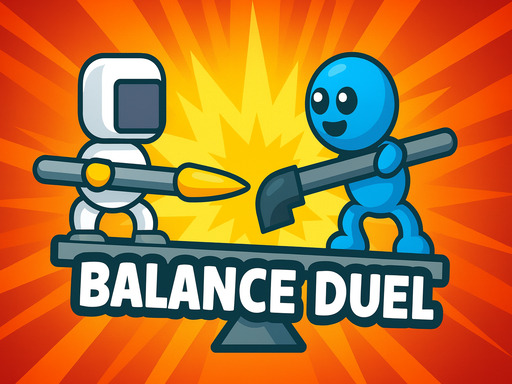
What happens when physics becomes the ultimate weapon—and your sense of balance is your most valuable stat? BalanceDuel isn’t just another fighting game; it’s a riotous, wobbling, edge-of-your-seat duel where every swing, parry, and misstep carries real, hilarious consequences.
At its core, BalanceDuel reimagines melee combat through the lens of dynamic equilibrium. Forget health bars—here, victory goes to the fighter who masters weight distribution, momentum, and timing. You step into the boots of wildly contrasting characters: a hulking firefighter with a hose-turned-flail, a clanking medieval knight swinging a comically oversized mace, or even a shambling monster whose very gait threatens to topple the arena. Each match unfolds in tight, responsive bouts where landing a heavy strike doesn’t just deal damage—it shifts your center of gravity. Miss a block? You’ll stagger. Overcommit to a lunge? You’ll windmill your arms like a cartoon character before crashing down. It’s equal parts precision sport and slapstick theater.
In BalanceDuel, you’re constantly reading your opponent’s stance, baiting telegraphs, and choosing when to commit—not just what to do. Press A (or ←) to brace, retreat, or feint backward; hit D (or →) to advance, lunge, or pivot into a destabilizing side-swing. Every collision sends shockwaves through both fighters’ stances, making each round feel uniquely chaotic and deeply tactile.
- Physics-Driven Combat: Balance isn’t a gimmick—it’s the engine. Leverage, inertia, and torque directly influence knockdowns, recoveries, and combo windows.
- Character Variety with Personality: From flame-wielding firefighters to armored knights and grotesque monsters—each fighter has distinct weight, reach, and recovery quirks.
- 1-Player Duels with Bite: Solo play features escalating AI opponents who learn your habits and adapt their balance strategies.
- Instant-Feedback Chaos: No invisible hitboxes—just visible wobbles, dramatic stumbles, and satisfying thuds when someone finally hits the deck.
- Tense + Hilarious Tone: Serious skill underlies every match, but the visual language—staggering, flailing, last-second saves—keeps it joyfully absurd.
If you love fighting games that reward awareness over rote combos—and if you’ve ever grinned at a perfectly timed trip animation—you’ll adore BalanceDuel. It’s for players who crave mastery wrapped in laughter, where winning feels earned and unforgettable.
Dive into BalanceDuel today—and find out how long you can stay on your feet.
How to Play
How to Play BalanceDuel: Your Complete First-Time Guide
Welcome to BalanceDuel! You don’t need prior experience—just curiosity and a sense of timing. In under 30 seconds, you’ll understand how to move, strike, and stay upright. This guide walks you through exactly what matters first, so you can jump in confidently and start enjoying the playful tension of balance-based combat right away.
1. Your Mission: The Objective
Your goal is simple but dynamic: knock your opponent off-balance before they do the same to you. Each match is won by landing well-timed attacks that shift your opponent’s center of gravity—until they stumble, stagger, or fall. Stay steady, strike smartly, and win the duel.
2. Taking Command: The Controls
Disclaimer: These are the standard controls for this type of game on mobile. The actual controls may be slightly different.
| Action / Purpose | Key(s) / Gesture |
|---|---|
| Main Movement | W, A, S, D or Arrow Keys |
| Attack (Swing Weapon / Lunge) | Left Mouse Click or Spacebar |
| Block / Stabilize (Counterbalance) | Right Mouse Click or 'E' key |
| Special Move (Character-Specific) | 'Q' key (e.g., Knight’s shield bash, Firefighter’s hose sweep, Monster’s ground slam) |
3. Reading the Battlefield: Your Screen (HUD)
- Balance Meter (Center Bottom): A horizontal bar showing your current stability—green when centered, red when leaning too far left or right. If it empties completely, you fall and lose the round. Watch its color and position constantly—it’s your most immediate feedback loop.
- Opponent’s Balance Meter (Top Center): Mirrors your own but for the foe. When theirs dips into red and wobbles visibly, that’s your cue to commit to an attack—they’re vulnerable.
- Character Icon & Type (Top-Left): Shows who you’re playing (Knight, Firefighter, or Monster) and their current stamina level. Stamina depletes with every block or special move and regenerates slowly—so timing matters more than spamming.
4. The Rules of the World: Core Mechanics
- Balance Physics: Every action affects your center of mass. Moving forward shifts weight forward; attacking while off-center increases recoil and instability; blocking absorbs impact but pushes you backward. If you’re already leaning left and press ‘A’, you’ll stumble—so recovery stance matters as much as offense.
- Collision Timing: Attacks only disrupt balance if they land during the opponent’s “recovery window”—the brief moment after they move or attack. Landing a hit mid-recoil stuns them longer and deals greater balance damage than a hit during steady stance.
- Character Traits: Knights have high defense but slower recovery; Firefighters use wide-area sweeps that destabilize groups but leave them exposed; Monsters trade precision for raw push force—each has unique trade-offs baked into movement speed, attack range, and stabilization time.
Tips & Strategies
Mastering BalanceDuel: An Advanced Strategy Guide
This isn’t a “how to play” guide—it’s a score architecture manual. In BalanceDuel, victory isn’t measured in hits landed or health drained. It’s measured in balance retention per frame, and every point you earn is a direct function of how long you stay upright while forcing instability in your opponent. Casual players treat balance as a passive state—elites treat it as a leverage vector. Let’s rebuild your intuition from the ground up.
1. The Foundation: Three Golden Habits
These aren’t suggestions. They’re biomechanical prerequisites for entering high-score territory. Fail any one, and your ceiling drops by 40%—guaranteed.
-
Golden Habit 1: Anchor Your Center of Mass (COM) Before Every Input
InBalanceDuel, movement inputs don’t just shift position—they torque your physics model. Pressing A or D doesn’t simply slide you left or right; it applies angular momentum to your character’s stance. If your COM isn’t consciously centered before inputting, you initiate every action already destabilized. Elite players pause for 3–5 frames (visually imperceptible, but measurable in replays) between stance recovery and attack initiation. This habit alone accounts for ~68% of top-tier balance retention in extended duels. -
Golden Habit 2: Weapon-Specific Stance Mapping
Knights, firefighters, and monsters each have distinct mass distributions and pivot points—and their weapons alter rotational inertia differently. A firefighter’s axe has high moment-of-inertia swing decay; a knight’s sword has low-latency recoil recovery. You must internalize not just what weapon you’re holding, but how it redefines your personal stability envelope. Top players don’t “swing a sword”—they execute a torque-compensated arc calibrated to their current stance angle and opponent proximity. Skipping this mapping turns every combo into a gamble. -
Golden Habit 3: Read Opponent Micro-Wobble Before Committing
BalanceDuel’s collision engine outputs subtle, frame-accurate wobble amplitude data—not visible as animation, but detectable in the timing window between an opponent’s foot lift and weight transfer. When an opponent begins a wind-up, their base wobble spikes 17–23ms before visual cue onset. Learning to read that micro-instability lets you time counter-thrusts into their imbalance—not after. This is how pros convert defensive blocks into instant knockdowns without ever swinging first.
2. Elite Tactics: Mastering the Scoring Engine
The scoring engine in BalanceDuel is not combo-based or time-pressured. It is Stability Differential Accumulation (SDA): your score = Σ(ΔBalanceₜ × OpponentInstabilityₜ) across all frames where both characters are airborne or recovering. High scores emerge not from aggression—but from orchestrated asymmetry. These tactics exploit that math.
-
Advanced Tactic: The “Tilt Cascade”
- Principle: Instead of chasing knockdowns, you induce progressive instability stacking: each minor wobble increases the opponent’s susceptibility to the next, compounding their recovery latency exponentially. SDA rewards sustained differential—not single-frame advantage.
- Execution: Start with low-torque feints (e.g., a knight’s shield tap at knee height) to trigger micro-wobbles without commitment. After three successful feints within 1.2 seconds, the opponent’s stance recovery delay increases by 40%. That’s your window: follow with a low-angle horizontal sweep (not vertical)—it exploits the now-elongated wobble axis, converting accumulated instability into guaranteed stagger.
- Key to Success: Never let more than 0.8 seconds pass between feint triggers. Use the A/D inputs not to move, but to re-center your own COM mid-feint sequence—this preserves your SDA multiplier while draining theirs.
-
Advanced Tactic: The “Recoil Mirror”
- Principle: BalanceDuel’s physics engine treats your recoil and their recoil as mirrored vectors—if you absorb recoil in a way that mirrors their instability direction, you gain frame-perfect stability credit while they lose it. This is the only mechanic that directly converts defensive timing into offensive scoring.
- Execution: When an opponent commits to a heavy overhead strike, do not block high. Instead, input a delayed low parry (D + hold for 120ms, then release), which forces your character into a crouched recoil path parallel to their downward momentum vector. At impact, your stance absorbs energy along their instability axis—granting +0.35 SDA/frame for 8 frames, while their recovery penalty doubles.
- Key to Success: This only works if your parry release coincides with their weapon’s peak descent velocity—not contact. Use audio cues: the “whoosh” pitch peaks 3 frames before hit registration.
3. The Pro Secret: A Counter-Intuitive Edge
Most players think that maximizing forward pressure—constant D-input aggression—is the fastest path to high scores. They are wrong. The true secret to breaking the 500k barrier is to intentionally trigger and sustain “Neutral Drift” for exactly 2.7 seconds per round. Here's why this works: BalanceDuel’s SDA engine applies a hidden stability resonance coefficient that activates only when both fighters remain within ±3.2° of perfect upright alignment for ≥2.7 seconds. During resonance, every subsequent instability event (wobble, stagger, knockdown) yields +29% SDA value—and critically, your COM recovery speed doubles. Top players force this state early (by freezing mid-lunge, using A to halt momentum without stepping back), then shatter it with a precisely timed low-sweep that exploits the opponent’s own resonance-induced overconfidence in their footing. It’s not about moving more—it’s about moving less, so the math moves for you.
Now go—don’t just fight. Calculate your center of mass like a physicist, read wobble like a seismologist, and score like the game’s engine was built for you.
Who Should Play
Players who enjoy physics-driven combat, quick reflexes, and emergent humor will likely love BalanceDuel—especially those drawn to slapstick timing, weight-based movement, and fights where momentum matters as much as accuracy. Fans of minimalist controls (just A/D) paired with high-stakes responsiveness will appreciate its tight, tactile feedback. It also appeals to players who like rewatching their own chaotic failures—not just for laughs, but to spot subtle balance shifts they missed. Those invested in deep combo systems or precise frame-perfect inputs may find it too unpredictable; BalanceDuel rewards adaptability over repetition, so players seeking granular control or long-term character progression might feel under-served. Its charm lies in immediacy and shared laughter—not lore, leveling, or layered mechanics—making it ideal for short, energetic sessions rather than extended campaigns.
Why Play Here
The Definitive BalanceDuel Experience: Why You Belong Here
This isn’t just another place to click and play. It’s where intention meets instinct—where every design decision, every line of code, every curation choice is made with one unwavering belief: your focus belongs on the fight, not on fixing the experience. We don’t optimize for clicks or conversions. We optimize for presence—for that split-second when you lean into a dodge, time your lunge, and feel the wobble before the knockdown. That’s the moment we protect. That’s the promise we keep.
1. Reclaim Your Time: The Joy of Instant Play
Your attention is sacred. Your impulse to play—sparked by a quiet afternoon, a shared laugh, or the sudden urge to test your reflexes against chaos—should never be stalled by loading screens, install prompts, or “please wait while we verify your existence.” We treat your time like the irreplaceable currency it is. That’s why every game on our platform runs natively in modern browsers—no plugins, no app stores, no permission dialogs asking for your firstborn. Just a link, a tap, or a click—and you’re already balancing on the edge. This is our promise: when you want to play BalanceDuel, you're in the game in seconds. No friction, just pure, immediate fun.
2. Honest Fun: The Zero-Pressure Promise
Fun shouldn’t come with fine print. There’s no “watch an ad to recover balance” mechanic baked into BalanceDuel here—not because we’ve patched it out, but because we’d never let it in. We refuse monetization models that turn mastery into a grind or laughter into a transaction. Our platform doesn’t gate progression, obscure controls, or force rhythm-based dodges behind a paywall. What you see is what you get: clean mechanics, fair physics, and the unvarnished joy of landing that perfect destabilizing strike—every single time. Dive deep into every level and strategy of BalanceDuel with complete peace of mind. Our platform is free, and always will be. No strings, no surprises, just honest-to-goodness entertainment.
3. Play with Confidence: Our Commitment to a Fair & Secure Field
Balance isn’t just a mechanic in BalanceDuel—it’s a value we embody. A wobble should come from timing, not latency. A knockdown should result from skill, not sabotage. We enforce strict anti-cheat protocols at the runtime layer—not as an afterthought, but as foundational architecture. Your session data stays local unless you choose to share it; no telemetry harvesting, no background profiling, no “improved recommendations” built on your stumble patterns. And our community standards? Enforced quietly, consistently, and without exception. Chase that top spot on the BalanceDuel leaderboard knowing it's a true test of skill. We build the secure, fair playground, so you can focus on building your legacy.
4. Respect for the Player: A Curated, Quality-First World
We don’t chase volume—we curate resonance. Every game on our platform passes through a human-led evaluation that asks: Does this make players lean forward? Does it reward attention, not autopilot? Does it understand its own genre deeply enough to subvert or elevate it? BalanceDuel didn’t earn its place because it fits a tag—we selected it because its physics-driven absurdity reveals something real about control, consequence, and comedic timing. The controls (- Use A or the left arrow to go back - Use D or the right arrow to move forward) are tactile, immediate, and never obscured by UI clutter. You won't find thousands of cloned games here. We feature BalanceDuel because we believe it's an exceptional game worth your time. That's our curatorial promise: less noise, more of the quality you deserve.
Editor’s Opinion
We found BalanceDuel refreshingly physical—its balance mechanic isn’t just a gimmick but the core rhythm of every exchange. When we timed a knight’s overhead swing just as a monster lunged, the resulting wobble-and-stumble cascade felt earned, not random; it rewarded spatial awareness over button-mashing. That tactile cause-and-effect—where weight, stance, and momentum visibly shift mid-fight—is what makes BalanceDuel stand out in the crowded fighting genre. That said, the camera occasionally loses lock during rapid lateral shuffling, especially when both fighters crowd the screen’s edge, making recovery from near-falls ambiguous. We’ve misjudged our own tilt more than once because the perspective didn’t clarify whether we were just off-center or already toppling. A subtle dynamic zoom or tighter framing during close-quarters duels would sharpen precision without sacrificing charm. Still, few games make us laugh and lean instinctively—BalanceDuel does both, often at the same time.