Checkers for two
Game Overview
Play Checkers for two: Where Strategy Meets Simplicity—And Still Packs a Punch!
What if the world’s most enduring strategy game got a sleek, modern upgrade—without losing a single ounce of its razor-sharp intellect? Checkers for two isn’t just checkers—it’s a tactile, visually grounded reimagining of the classic, built for quick sessions and deep thought alike.
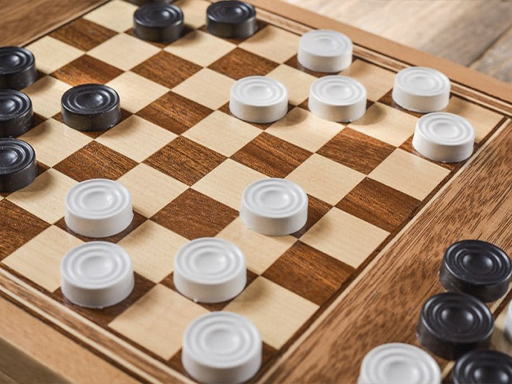
At its heart, Checkers for two delivers the timeless elegance of traditional checkers—but with intuitive 3D presentation, responsive controls, and thoughtful design that welcomes newcomers while respecting veterans. You’re not just moving pieces—you’re orchestrating diagonal advances across a high-contrast board, calculating forced jumps, weighing trade-offs between aggression and defense, and racing to crown your kings before your opponent does. Whether you’re squaring off against a friend on the same screen or challenging AI opponents across three distinct difficulty tiers—from patient beginner to ruthlessly opportunistic—the game adapts without compromising authenticity.
In Checkers for two, every move is deliberate: click a black-square-bound checker, then click a valid destination square—always advancing toward your opponent’s side. Capture by leaping over adjacent enemy pieces (diagonally, of course), and watch as crowned kings gain the power to move—and jump—both forward and backward. There are no hidden rules, no RNG surprises—just pure spatial reasoning, foresight, and nerve.
- True 2-Player Local Play: No accounts, no downloads—just grab a friend and go head-to-head in seconds
- Smart, Scalable AI: From gentle guidance for learners to tight, tactical pressure for seasoned players
- Immersive 3D Board: Clean, modern visuals with subtle depth and lighting—crisp enough for long sessions, calming enough for casual play
- Pure Logic Focus: Zero distractions—no timers, no ads, no power-ups—just you, your opponent, and the board
- Educational by Design: Reinforces pattern recognition, forward planning, and consequence evaluation in an effortlessly engaging way
You’ll love Checkers for two if you crave games that reward patience over reflexes—if you’ve ever paused mid-move to visualize three turns ahead, or smiled when a perfectly timed jump flipped the momentum of a match. It’s ideal for families looking for screen time with substance, students sharpening analytical thinking, or anyone who believes great gameplay doesn’t need explosions to be electrifying.
Dive into Checkers for two today—and rediscover why, over 500 years later, two colors, sixteen pieces, and a single rule set still hold our minds spellbound.
How to Play
How to Play Checkers for two: Your Complete First-Time Guide
Welcome! You’re about to learn checkers—the timeless game of strategy, foresight, and elegant simplicity. Don’t worry if you’ve never played before. This guide breaks everything down into clear, bite-sized steps. In under two minutes, you’ll understand how to move, capture, and think ahead—and you’ll make your first confident move before you know it.
1. Your Mission: The Objective
Your goal is to eliminate all of your opponent’s checkers—or block them so they cannot make a legal move. A deeper, more rewarding objective emerges as you play: crown one of your own checkers by moving it to the farthest row (the “king row”) on your opponent’s side of the board. Once crowned, that piece gains new powers—and becomes your most valuable asset.
2. Taking Command: The Controls
Disclaimer: These are the standard controls for this type of game on mobile. The actual controls may be slightly different.
| Action / Purpose | Key(s) / Gesture |
|---|---|
| Select a Checker | Tap or click on any of your checkers (red or black, depending on your assigned color) |
| Confirm a Move | Tap or click on an empty black square diagonally forward—toward your opponent’s side of the board |
| Execute a Jump (Capture) | Tap or click your checker, then tap or click the empty black square immediately beyond an adjacent opponent’s checker (diagonally forward only) |
3. Reading the Battlefield: Your Screen (HUD)
- The Board Layout: A classic 8×8 grid with alternating light and dark squares—only the 32 black squares are playable. Your pieces start on the three rows closest to you; your opponent’s occupy the three rows farthest away. This visual symmetry helps you instantly orient yourself and plan directionally.
- Turn Indicator: A subtle banner (e.g., “Your Turn” or “Opponent’s Turn”) appears at the top center. It confirms whose move it is—eliminating uncertainty and reinforcing turn-based rhythm.
- King Markers: When one of your checkers reaches the opponent’s back row, it transforms—visually marked with a second layer or crown icon. This signals its upgraded movement capability and reminds you to protect it.
4. The Rules of the World: Core Mechanics
- Movement Is Directional & Restricted: You can only move your checkers diagonally forward onto empty black squares—and only toward your opponent’s side of the board. This constraint shapes every decision: backward movement is illegal for regular checkers, and stepping onto a white square or moving sideways ends your turn with no effect.
- Jumping Is Mandatory and Cascading: If an opponent’s checker sits diagonally adjacent to one of yours—and the square immediately beyond it (in the same diagonal line) is empty—you must jump over it and land there. If that landing position then enables another jump in the same turn, you must take it—no exceptions. Capturing isn’t optional; it’s the engine of pressure and control.
- Kings Change the Game: A crowned checker can move and jump both forward and backward along diagonals. This freedom breaks stalemates, unlocks flanking maneuvers, and rewards patience—but kings remain vulnerable to jumps just like regular pieces. Their power lies in flexibility, not invincibility.
Who Should Play
Players who enjoy deliberate, turn-based strategy—especially those drawn to spatial reasoning and forward planning—will find Checkers for two satisfying. It appeals to casual gamers seeking low-barrier, high-replay logic puzzles, as well as families looking for screen-shared, rule-transparent competition. Fans of classic board games or digital adaptations that preserve tactical depth (like Chess or Othello) will appreciate its clean execution and adjustable AI difficulty. Educators or parents may value its subtle reinforcement of foresight and consequence evaluation. However, players who prefer fast-paced action, real-time reflex challenges, or highly narrative-driven experiences are unlikely to connect with its methodical pace and abstract mechanics. The 3D presentation adds visual polish without compromising clarity—a plus for those who like modern aesthetics but dislike cluttered interfaces. Ultimately, it suits anyone who finds satisfaction in outmaneuvering an opponent one careful diagonal step at a time.
Why Play Here
The Definitive Checkers for two Experience: Why You Belong Here
This isn’t just another place to play checkers. It’s where intention meets instinct—where decades of tradition meet a platform built around you, not around ads, latency, or compromise. We don’t ask you to adapt to the game; we adapt everything else so that when you sit down to play Checkers for two, all that remains is the quiet intensity of a well-placed jump, the satisfaction of a forced capture, and the unbroken flow of thought between moves. We handle all the friction, so you can focus purely on the fun.
1. Reclaim Your Time: The Joy of Instant Play
Your attention is finite. Your curiosity is immediate. Waiting for downloads, wrestling with permissions, or hunting for the right browser tab shouldn’t be part of the ritual of playing checkers—it should begin the moment you decide to play. That’s why every game on our platform loads instantly in any modern browser, no installation, no sign-up, no redirects. This is our promise: when you want to play Checkers for two, you're in the game in seconds. No friction, just pure, immediate fun. To make a move click or click on the checker and then click or click on the next cell All moves should be made towards the edge of the opponents board you can only walk on black squares You can walk diagonally Jumping over the opponents checkers — and you’re already doing it, without delay, without distraction.
2. Honest Fun: The Zero-Pressure Promise
There’s a quiet dignity in games that don’t demand anything beyond your presence and your mind. No paywalls hiding advanced strategies, no “energy” systems gating your turn, no forced waits before replaying a match—you’re never asked to trade your time, data, or dignity for access to the full experience. Dive deep into every level and strategy of Checkers for two with complete peace of mind. Our platform is free, and always will be. No strings, no surprises, just honest-to-goodness entertainment—because great games shouldn’t come with fine print.
3. Play with Confidence: Our Commitment to a Fair & Secure Field
A perfect jump feels earned—not granted by a glitch, a lag spike, or an opponent exploiting a loophole. We treat fairness as infrastructure: deterministic move validation, server-side state integrity for multiplayer matches, and strict anti-cheat protocols that preserve the integrity of every capture, every kinging, every forced jump. Chase that top spot on the Checkers for two leaderboard knowing it's a true test of skill. We build the secure, fair playground, so you can focus on building your legacy—not debugging the rules.
4. Respect for the Player: A Curated, Quality-First World
We don’t believe in flooding your screen with noise. Every game on our platform passes two uncompromising filters: it must be deeply playable and meaningfully designed—not just functional, but thoughtful. Checkers for two wasn’t added because it’s familiar; it was chosen because its clean logic, tactile movement system, and layered strategy reward attention, patience, and growth. You won't find thousands of cloned games here. We feature Checkers for two because we believe it's an exceptional game worth your time. That's our curatorial promise: less noise, more of the quality you deserve.
Editor’s Opinion
We’ve spent several sessions with Checkers for two, and what stands out is its clean, intuitive move execution—clicking a piece then its destination feels responsive and uncluttered, even for newcomers. The diagonal-only movement and forced jumps are implemented faithfully, and the black-square restriction never trips us up mid-game. That said, the 3D perspective, while visually distinct, occasionally obscures piece hierarchy during tight endgames; we’ve misjudged a king’s elevation or missed a potential jump because depth cues didn’t align with spatial logic. It’s not a dealbreaker, but flattening the view slightly—or adding subtle shadowing—would sharpen tactical clarity. We also appreciate how smoothly it toggles between human-vs-human and AI modes, though the computer’s “easy” level sometimes makes inexplicably passive moves, undermining its pedagogical value. Still, as a no-frills, accessible checkers implementation that prioritizes play over flash, it earns our repeat visits.
Short Analysis
Checkers for two excels in short sessions: a single game typically lasts 80–100 seconds when both players act decisively—no downtime, no menus between moves, and no loading. The turn-based rhythm fits naturally into micro-breaks, and the absence of timers or penalties encourages thoughtful but brisk play. Since matches rarely exceed 20 moves (especially at beginner/intermediate levels), players can complete a full, satisfying round without context-switching fatigue. Replay value stems not from progression systems, but from immediate asymmetry—each match unfolds differently based on opponent habits, piece positioning, and forced jumps. The dual mode (human vs. human or human vs. AI) adds subtle variety: playing against a person introduces unpredictability; against AI, adjusting difficulty changes pacing and tension without altering core flow.