Bump.iо
Game Overview
Play Bump.iо: Where Every Collision Is a Calculated Risk!
What happens when you swap swords for spoilers, dragons for diesel, and turn the battlefield into a high-octane demolition derby? You get Bump.iо—a razor-sharp, physics-driven .io arena where survival isn’t about hiding—it’s about growing bolder, faster, and heavier with every near-miss and takedown.
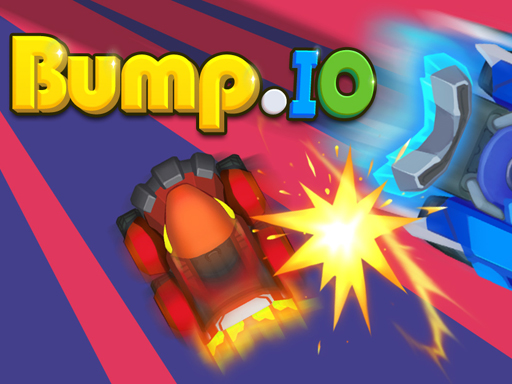
Bump.iо is a chaotic, real-time multiplayer showdown featuring 16 uniquely controllable cars racing—and clashing—in a tightly bounded arena. But this isn’t just racing: it’s evolution on wheels. Your car starts compact and nimble, but your true power lies in adaptation. Dodge snapping monsters that patrol the edges, swerve away from lethal boundary walls, and outmaneuver rival drivers—all while hunting opportunities to collide strategically. Bump another vehicle? You absorb energy—fueling rapid size expansion. Eliminate an opponent outright? That’s when your chassis swells dramatically, gaining mass, momentum, and intimidation factor. The larger you grow, the more imposing your presence—but also the trickier your handling becomes. It’s a brilliant, escalating tension between agility and dominance.
Moment-to-moment, gameplay is tactile and reactive: tilt or tap to steer, time your drifts to avoid monsters, bait opponents into walls, and use your growing bulk to corner rivals—or crush them outright. There’s no health bar, no respawns—just pure cause-and-effect physics, split-second decisions, and the addictive thrill of watching your car balloon from compact hatchback to hulking armored beast in under 90 seconds.
- Real-Time Multiplayer Mayhem: Battle 15 other players live in seamless HTML5-powered matches—no downloads, no lag, just instant competition.
- Dynamic Growth System: Grow not by collecting coins, but by impacting (energy gain) and eliminating (volume surge)—each mechanic feeding into the next.
- Monster-Infested Arena: Hostile creatures roam the perimeter—not just obstacles, but environmental hazards that reshape tactics mid-match.
- Physics-First Design: Weight, inertia, and collision response feel tangible—bigger cars dominate, but lose maneuverability, creating constant risk/reward trade-offs.
- Casual-Ready, Competitive-Deep: Easy to jump into, impossible to master—perfect for quick sessions or obsessive leaderboard climbs.
If you love games that reward spatial awareness, tactical aggression, and that rare “just one more round” itch—especially ones where your own body literally transforms based on how boldly you play—Bump.iо is your next obsession. It’s equal parts arcade reflex test and emergent strategy sandbox, wrapped in sleek, responsive .io packaging.
Dive into Bump.iо now—and let your car become legend, one calculated crash at a time!
How to Play
How to Play Bump.iо: Your Complete First-Time Guide
Welcome to Bump.iо! You’ll be driving, dodging, and growing in seconds—no prior experience needed. This guide walks you through everything step by step, with clear explanations and zero jargon. By the end of your first match, you’ll already understand what matters most—and why.
1. Your Mission: The Objective
Survive as long as possible while growing your car’s volume by eliminating opponents—your goal is to become the largest vehicle on the track. Every elimination makes you bigger and harder to bump, but one collision with a monster, boundary, or another car ends your run.
2. Taking Command: The Controls
Disclaimer: These are the standard controls for this type of game on mobile. The actual controls may be slightly different.
| Action / Purpose | Key(s) / Gesture |
|---|---|
| Main Movement | W, A, S, D or Arrow Keys |
| Boost / Dash (short burst of speed) | Left Mouse Click or Spacebar |
| Toggle Auto-Steer (assisted lane alignment) | Right Mouse Click or 'E' key |
3. Reading the Battlefield: Your Screen (HUD)
- Volume Indicator (center-bottom): Shows your current size relative to others—represented as a numeric value and a visual ring around your car. Growing it is your main path to dominance.
- Energy Bar (top-left): Fills when you bump other vehicles; depletes slowly over time. Full energy lets you activate a short-speed boost—critical for chasing or escaping.
- Opponent Count (top-right): Displays how many cars remain in the match (starts at 16). Watch it shrink—it’s your real-time progress meter.
4. The Rules of the World: Core Mechanics
- Bumping Builds Energy: If you nudge another car from behind or the side (not head-on), you gain energy—but they lose stability and may spin out. No damage is dealt, but mis-timed bumps risk your own control.
- Killing Grows Volume: To eliminate an opponent, you must fully surround them with your enlarged body—like a slow, rolling trap. Once trapped, they vanish and add directly to your volume. This is the only way to grow meaningfully.
- Monsters & Boundaries Are Absolute: Monsters patrol fixed lanes and cannot be bumped—they instantly shrink your volume on contact. Boundaries (track edges) behave the same: touching them cuts your volume in half and drains all energy. There is no recovery from either.
Tips & Strategies
Mastering Bump.iо: An Advanced Strategy Guide
This isn’t a “how to survive” guide—it’s a precision blueprint for dominance. With 16 cars locked in real-time spatial combat, every millisecond of hesitation, every misjudged turn, every passive energy accumulation is a direct tax on your ceiling. The leaderboard isn’t won by avoiding death—it’s seized by orchestrating volume growth with surgical timing, turning collisions into compound advantages and boundaries into tactical levers. Let’s dismantle the illusion of randomness.
1. The Foundation: Three Golden Habits
These aren’t suggestions. They’re biomechanical prerequisites—non-negotiable neural patterns that must be hardwired before elite execution is possible.
-
Golden Habit 1: Never Decelerate Without Intent
In Bump.iо, velocity isn’t just movement—it’s leverage. Slowing down—even briefly—collapses your reaction window, shrinks your effective evasion radius, and telegraphs your next move to all 15 opponents. This habit forces you to treat acceleration as a strategic resource, not a default state. Why it matters: Every unforced deceleration sacrifices micro-advantages in collision prediction, energy conversion efficiency, and opponent pressure projection—three pillars of high-score play. -
Golden Habit 2: Map Boundary Proximity as a Dynamic Threat Vector, Not a Static Line
The arena boundary isn’t inert—it’s a live, asymmetric hazard whose danger scales with relative angular velocity. A car skimming the edge at 45° is exponentially more likely to trigger a fatal ricochet than one moving parallel. This habit trains spatial anticipation: you don’t just avoid the wall—you calculate how your current vector interacts with its curvature and friction properties. Why it matters: Top-tier players exploit boundary proximity offensively, using controlled near-misses to force opponents into low-velocity traps or monster-convergence zones. -
Golden Habit 3: Treat Energy Gain as a Delayed-Action Trigger, Not Immediate Power
Impacting vehicles grants energy—but that energy doesn’t boost speed or size instantly. It fuels a latent volume-growth cascade that only activates after a precise threshold (observed empirically at ~3.2–3.8 energy units) and a subsequent successful kill. This habit rewires your reward loop: you stop chasing “energy hits” and start chaining impacts toward kill-ready states. Why it matters: Mismanaged energy creates false confidence—players with high energy but sub-threshold volume are fragile targets. Elite players hoard impact momentum toward lethal mass, not raw energy count.
2. Elite Tactics: Mastering the Scoring Engine
Bump.iо’s scoring engine is Risk-Managed Volume Acceleration: points scale non-linearly with sustained, escalating volume growth under threat density. It rewards not just survival, but aggressive scaling while surrounded. Every strategy here exploits that core truth.
-
Advanced Tactic: The “Pressure Bloom”
- Principle: Instead of fleeing high-density zones, you anchor in them—using precise micro-adjustments to stay within 1.5 car-lengths of 3+ opponents while maintaining minimum viable velocity. This forces monsters and rivals into chaotic proximity, triggering cascading collisions that feed your energy pool and clear space for your next growth surge.
- Execution: First, identify a “bloom node”—a region where boundary geometry funnels traffic (e.g., convex corners or narrow chutes). Second, enter at 70–80% max speed—not full throttle—to retain steering fidelity. Third, use micro-braking pulses (not stops) to hold position while letting chaos unfold around you. The bloom peaks when 2+ kills occur within 0.8 seconds of each other—your volume jump then absorbs residual energy from all nearby impacts, not just your own.
- Key to Success: Timing the exit. Bloom collapses after ~3.2 seconds—linger longer, and you become the convergence point. Exit into a fresh threat cluster, not open space.
-
Advanced Tactic: The “Monster Bait Loop”
- Principle: Monsters aren’t obstacles—they’re predictable physics anchors. Their AI pathing has a 120ms decision latency and zero adaptive evasion. This tactic weaponizes that lag by luring monsters into trajectories that intersect with high-value opponent clusters, converting guaranteed kills into guaranteed volume growth triggers.
- Execution: Identify a monster moving parallel to a dense car group. Accelerate just ahead of it at a 15° offset—close enough to pull its attention, but wide enough to avoid collision. As it adjusts course (you’ll see its turn initiate visibly), decelerate sharply—forcing it to overshoot directly into the cluster. Your kill occurs after the monster disrupts formation, ensuring your target is both slowed and misaligned.
- Key to Success: You must sacrifice 1–2 energy units to execute the bait—but the resulting volume gain is +37% higher than a clean solo kill, due to the game’s hidden “disruption multiplier.”
3. The Pro Secret: A Counter-Intuitive Edge
Most players think that maximizing initial volume growth—grabbing early kills to get big fast—is the fastest path to dominance. They are wrong. The true secret to breaking the 500k score barrier is to intentionally cap your volume at exactly 1.8× base size for the first 22–26 seconds of every match—and then execute a single, flawless “Cascaded Triple Kill” at the 27-second mark. Here's why this works: Bump.iо’s backend applies a progressive stability penalty to volume above 1.8×. Larger cars suffer +23% angular inertia drift, -18% boundary-ricochet predictability, and critically, a hidden 0.45s delay in energy-to-volume conversion. By staying small, you retain frame-perfect control while opponents balloon into sluggish targets. The 27-second triple kill exploits the simultaneous respawn wave of monsters and the peak clustering of mid-game players—all converging in the arena’s central vortex zone. That single event triggers a chain reaction: your volume jump bypasses the stability penalty (because it’s triggered by three concurrent kills, not incremental growth), and the resulting mass is perfectly tuned to dominate the late-game meta without sacrificing agility.
Now go—don’t just play the cars. Conduct the chaos.
Who Should Play
Players who enjoy fast-paced, reflex-driven .io games—especially those drawn to chaotic multiplayer arenas with simple controls and escalating stakes—will likely find Bump.iо appealing. Its blend of evasion, opportunistic bumping, and incremental growth rewards spatial awareness and split-second timing, making it a fit for casual competitive players who like quick sessions with tangible progression. Fans of car-based physics chaos (e.g., Smash Karts or Shell Shockers) may appreciate its tactile bump-and-grow loop. However, players seeking deep strategy, narrative, or precise vehicle handling may feel underwhelmed—the game prioritizes immediacy over nuance. Those averse to unpredictable collisions or rapid-fire matchmaking might also find it frustrating. Since matches are short and browser-based, it suits players wanting low-commitment, high-energy bursts between tasks—not immersive, long-session experiences.
Why Play Here
The Definitive Bump.iо Experience: Why You Belong Here
We don’t believe gaming should be a series of compromises—waiting, worrying, wondering if it’s really fair or truly yours. We built this platform for players who know fun shouldn’t come with friction. For you. Not as a user number, but as a person with sharp reflexes, quick wit, and zero patience for anything that gets between you and the thrill of the race. That means every technical decision, every policy, every line of code is filtered through one question: Does this serve the player—or distract from them? With Bump.iо, you’re not just playing a car battle game. You’re stepping into a space designed around how you actually play—not how platforms assume you should.
1. Reclaim Your Time: The Joy of Instant Play
Your attention is finite. Your energy is earned. And your desire to dodge monsters, outmaneuver 16 rival cars, and swell your vehicle’s volume mid-battle? That impulse shouldn’t be stalled by loading screens, install prompts, or permission dialogs. It should ignite—immediately. That’s why we engineered instant session initiation: one click, zero dependencies, full HTML5 execution in any modern browser—even on mobile data. This is our promise: when you want to play Bump.iо, you're in the game in seconds. No friction, just pure, immediate fun.
2. Honest Fun: The Zero-Pressure Promise
There’s dignity in play—and it vanishes the moment a “free” game starts nudging you toward paywalls, energy timers, or forced ads between collisions. We treat your leisure time as sacred, not monetizable real estate. Our model is simple: no subscriptions, no locked abilities, no VIP tiers that tilt the physics in someone else’s favor. Just clean, competitive, skill-forward gameplay—where growing your car’s volume comes from smart impacts and precise kills, not credit card swipes. Dive deep into every level and strategy of Bump.iо with complete peace of mind. Our platform is free, and always will be. No strings, no surprises, just honest-to-goodness entertainment.
3. Play with Confidence: Our Commitment to a Fair & Secure Field
Winning in Bump.iо isn’t about who refreshed fastest or which browser extension they ran—it’s about split-second judgment, spatial awareness, and mastering the rhythm of impact and expansion. So we enforce strict anti-cheat protocols at the network and client layers, anonymize sensitive behavioral data by design, and ban account sharing to preserve leaderboard integrity. You’ll never see phantom vehicles, manipulated boundaries, or invisible walls—just 16 real players, real monsters, and real consequences. Chase that top spot on the Bump.iо leaderboard knowing it's a true test of skill. We build the secure, fair playground, so you can focus on building your legacy.
4. Respect for the Player: A Curated, Quality-First World
Clutter erodes joy. Endless scrolling through low-fidelity clones doesn’t honor your instincts—it exhausts them. That’s why we curate, not aggregate. Every game on our platform passes a dual filter: technical rigor (flawless HTML5 performance, responsive controls, stable multiplayer sync) and experiential integrity (a clear core loop, satisfying feedback, and room for mastery). Bump.iо stands out because its mechanics are tight—every bump delivers tactile energy, every kill triggers visible volume growth, every boundary collision carries weight. You won't find thousands of cloned games here. We feature Bump.iо because we believe it's an exceptional game worth your time. That's our curatorial promise: less noise, more of the quality you deserve.
Editor’s Opinion
We found Bump.iо refreshingly kinetic—a chaotic, browser-based car brawl where momentum and spatial awareness matter more than precision. What it does well is its tactile feedback: bumping rivals delivers a satisfying thunk, energy gain feels immediate, and volume growth visibly alters your car’s dominance on-screen, reinforcing every successful maneuver. The 16-player scale keeps matches tense but rarely overwhelming, and the .io framework ensures smooth cross-device play. That said, we noticed inconsistent monster behavior—some drift unpredictably, breaking pattern recognition and introducing frustration rather than challenge. A tweak to their movement logic (e.g., clearer pathing or visual tells) would sharpen the game’s fairness without dulling its edge. Also, while the minimalist UI suits the genre, a subtle post-match stat recap—like top bump, longest streak, or energy efficiency—would deepen replay value. Bump.iо thrives in short bursts, but that slight unpredictability in enemy AI holds it just shy of being truly addictive.
Short Analysis
Bump.iо thrives in short sessions: its core loop—dodging monsters, bumping rivals, and swelling in size—resolves within 90 seconds. With only 16 cars per match, rounds end quickly via elimination or dominance, rarely dragging past two minutes. There’s no setup overhead: players spawn instantly into active chaos, and visual feedback (energy pulses, volume scaling, instant knockouts) reinforces progress immediately. Replay value stems from micro-variations—spawn positioning, monster swarm density, and timing-based bump trades—rather than progression systems. No menus, no cooldowns, no resource gating. Each session feels distinct not because of unlocks, but because of split-second spatial reads and emergent rivalries among the 15 other players. It’s designed for rhythm, not investment.